
Laying the Groundwork: Building Data Foundations for the AI-Powered Future
Essential building blocks for a modern, AI-ready data estate — from cloud-native platforms and real-time pipelines to governance, integration, and security
TECHNOLOGY
11/19/20253 min read
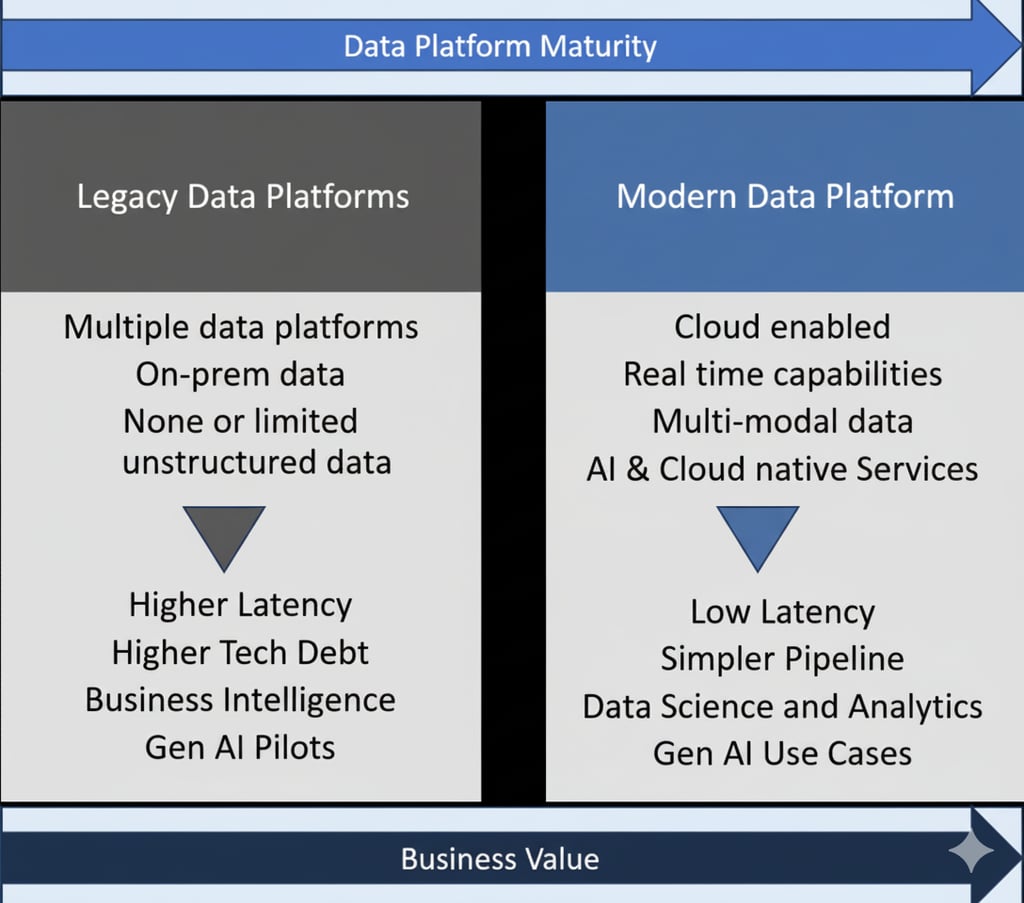
To scale AI initiatives effectively, enterprises are transforming their data platforms—shifting from fragmented, high-latency architectures to unified, cloud-native solutions with real-time capabilities. Insights from Google Cloud, AWS, Microsoft, and CIO.com underscore the strategic importance of establishing a resilient data foundation to support innovation and agility in the AI era.
🧠 Why Data Foundations Matter for AI
AI offers transformative potential in automation, insight generation, and innovation—but its effectiveness is fundamentally tied to the quality and integrity of the underlying data. McKinsey reports that 70% of organizations implementing generative AI face challenges with data governance, integration, and readiness. In the absence of a robust data foundation, AI models are prone to inaccuracies, bias, and operational failure. Safeguarding sensitive enterprise data from theft, misuse, and leakage within AI systems demands a comprehensive approach—combining technical safeguards, policy frameworks, and human-centric oversight.
🧱 Four Pillars of a Modern AI-Ready Data Foundation
Goal: Reduce latency and tech debt while unlocking cloud scalability
1. Modernize Your Data Estate
Retire legacy systems and consolidate fragmented on-prem environments
Adopt cloud-native storage and compute for scalability and agility
Enable real-time ingestion via streaming tools
Goal: Align data strategy with business goals and AI ambitions
2. Assess and Envision Future State
Conduct a data maturity assessment across structure, quality, and accessibility
Define a target architecture aligned with AI use cases—e.g., predictive analytics, GenAI copilots, intelligent search
Build a roadmap that includes governance, metadata management, and semantic modeling
Goal: Enable scalable, reusable AI across domains and applications
3. Innovate with AI and Cloud-Native Services
Integrate ML and GenAI capabilities into applications using cloud AI Services
Use data Lakehouse to unify structured and unstructured data for model training
Leverage semantic layers and feature stores to standardize inputs for AI models
Goal: Make AI accessible, trusted, and actionable across the enterprise
4. Democratize AI and Analytics
Empower business users with self-service tools
Implement data catalogs and lineage tools for transparency
Promote data literacy and governance through training and policy enforcement
🚀 Strategic Takeaways
Cloud-first architectures are no longer optional—they’re foundational
Unified metadata and governance are critical for trust and compliance
Real-time, multi-modal data (text, image, voice) is essential for GenAI success
Executive alignment is key—data strategy must be a board-level priority
Achieving AI maturity starts with establishing a robust data foundation. Through infrastructure modernization, strategic alignment, and democratized data access, enterprises can fully harness the transformative capabilities of generative AI.
Related Content & Sources:
1. AWS: Ultimate Guide to Building a Data Foundations
AI generated Summary:
To build a strong data foundation in the generative AI era, organizations must prioritize scalability, integration, and intelligence.
Data is the differentiator for generative AI, enabling personalized, high-impact applications across industries
Four key pillars—comprehensive, integrated, governed, and intelligent—form the backbone of a modern data foundation
AWS offers a unified platform with tools like SageMaker and zero-ETL integrations to break down silos and accelerate AI development
Robust governance and security frameworks ensure responsible data access, privacy, and compliance at scale
Case studies from BMW, ADP, and ENGIE highlight real-world success in transforming operations and innovation
2. Microsoft: Unified and AI Powered Data Estate with Microsoft Fabric
AI generated Summary:
Microsoft is unifying its data services through Microsoft Fabric and Azure databases to power AI-driven innovation.
Microsoft Fabric integrates data engineering, warehousing, real-time analytics, and business intelligence into a single SaaS platform, streamlining data workflows
Azure databases like Cosmos DB, SQL, and PostgreSQL now offer deeper integration with Fabric, enabling seamless data movement and real-time insights
Copilot experiences are embedded across services, allowing users to interact with data using natural language and generate AI-powered insights
Unified governance and security ensure compliance and trust across the entire data estate
This approach empowers organizations to modernize legacy systems, accelerate development, and unlock the full potential of their data for AI
3. Google Cloud: 5 Steps to Build Strong Data Foundations for GenAI
AI generated Summary:
To build strong data foundations for generative AI, organizations must adopt a strategic, scalable approach.
Start with an AI-first data strategy that aligns with business goals and treats data as a strategic asset
Create a unified data platform to eliminate silos and enable access to all data types, including unstructured formats
Use AI to accelerate data workflows, enabling natural language queries and conversational analytics for broader accessibility
Implement robust governance and security, ensuring data quality, compliance, and protection across the lifecycle
Optimize for efficiency and cost, leveraging managed services and cloud FinOps to scale AI initiatives sustainably
4. CIO.com: Building Data Foundations for AI Explorations
AI generated Summary:
To build effective data foundations for AI, CIOs must prioritize agility, scalability, and strategic alignment.
AI success depends on reliable, modular data infrastructure that can adapt to rapid technological shifts
Cloud platforms and hybrid architectures enable scalable, secure environments for AI experimentation and deployment
Use-case driven development—like HPE’s ChatHPE and Virgin Atlantic’s Databricks—helps unlock business value from internal data
Self-service data access empowers business users, reducing reliance on IT and accelerating insights
Strategic investment in performance and reliability, not just speed, ensures long-term sustainability of AI initiatives